The Speed Graphic:
the mystery solved thanks to those nice guys at www.graflex.org . My thanks to Dann Fromm, 45PSS and the others who helped explain my camera's oddities.
The back on the camera appears to have an after sales modified spring kit to admit a roll film holder. Obviously this makes it a bit tricky to use other lenses, without a ground glass to focus on. However its perfectly serviceable with its current lens and rangefinder setup.
The lens is 1938 and although the manual is newer, the camera itself is likely to have been produced in a batch in 1940. So now I know.
see:
http://www.graflex.org/helpboard/viewtopic.php?t=5928
I need to check the RF and try a roll or two now and see if the holder is OK !
Thursday, January 13, 2011

Wednesday, December 22, 2010


Wednesday, November 24, 2010
So it been a long term interest of mine that the primary supply of energy in the world today is a limited resource. Its part of human nature to spend ones resources until a habit is formed before suddenly realising the barrel is nearly empty. So for many decades now we have used almost free energy with not a lot of interest in the cost and the sustainability of supply.
Go look at : http://www.theoildrum.com/tag/update
There you can see the work of people who have analysed the oil supply who dont have a vested economic or social interest. If this prediction ( the mean of a number of learned peoples estimates) is correct then the following might well be the case in as little as 5 yrs.
Cars will be a serious luxury affordable by the very rich only
Food will become the most expensive commodity in our lives
The world economy will never get out of its current spin and back to full 'growth'
Why? Because the cost of oil is in nearly everything we do. The food we eat, our transport costs, the cost of nearly all our goods, and the costs of heating and water.
Politicians don't like to talk about this issue because there is no way they can get votes for it. Its an uncomfortable truth to be ignored in case they get the blame for not having prepared. Instead they discuss global warming - which is more likely to be a natural phenomenon and out of our control in reality (thats another debate).
The current western society is completely unsustainable in a world where oil is in limited supply. The in-elasticity of the supply of oil means that prices will be highly volatile. Soon the $150 peak we saw in 2008 will be a normal and frequent occurrence - its no mystery that every time the world economy tries to get going again, the oil price rises sharply. That is because oil supply can only just keep up with demand.
And despite an exponential increase in exploration, the number large fields being discovered is diminishing steadily. Sure there is half as much left as we've all burnt so far - but that half is mostly hard to get to, and will cost more to extract - Energy return on energy invested will fall from 8:1 to 2:1 before we are well through the existing 'reserves', making that oil do less useful work for us. And yet al the time global population and demand for energy is every increasing.
So what to do? Well I'd make sure you have some land to grow veg on, keep a horse and grow some wood for the winter. And try to cut your energy consumption by a factor of 10. Don't live in the desert, build houses that have thermal mass and good insulation, drive cars that are better than 0.5% efficient in practise, install a ground source heat pump. etc. etc.
As long as the pace of change isn't too fast, it could actually be a whole load of fun learning how to survive in the post oil era, making better use of energy and learning some good basic skills.
Thursday, November 18, 2010
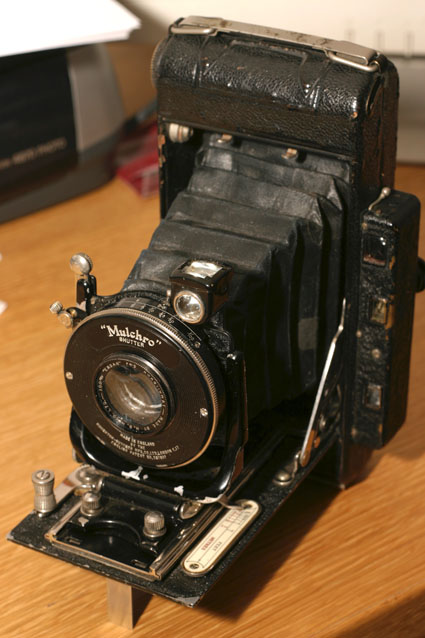
This is anEnsign Autorange 20 by Houghton-Butcher. A folding medium format roll film camera from the 1930's. It is equipped with a 100mm F1:4.5 Ensar Anastigmat in a 'Mulchro' shutter. Serial no. H23908, probably from the late 1930's
When I bought it, the shutter was sticking and the lens was cloudy. Also the rangefinder was filthy and the door wouldnt close properly.
The lens cleaned up easily - someone had squirted light oil into the shutter and this had got onto the lenses. The glass is now clear and showing only a few light cleaning marks.
The self cocking "mulchro" shutter was another story. Its a crude design and relies on the rather soft brass parts to keep their shape with some accuracy. There are several pawls which run up ramps to catch and they are quite worn. Also the B/T mechanism requires undue precision from some of the levers and wear and tear has made this unreliable. Worst of all the main pinion that engages the segment arm of the timing mechanism is well worn and didn't always stay engaged with the segment arm.
 Basically the shutter is worn out. In the past some of the arms have been bent with pliers to make up for worn out pawls. In doing so the slow times got shortened and this had to be sorted out by very careful bending of some of the internal levers to return them to their intended travel. There is no gear train mechanism like a compur just a rather odd star wheel escapement and a lever with a gear segment.
I managed to sort out most of its trobles, but the B/T mechanism is beyond help. B is OK but T is unreliable and sometimes the shutter closes immediately. After using B or T you must turn the shutter to 1/100th and back to release the timing mechanism. Still it works well enough for me to put a film in this weekend.
One odd thing with this camera is that it has rise and cross slide movements (about 12mm each - see right..). This is puzzling as the lens - a triplet, like a cooke lens - ought to only barely cover the 6x9 film format. Also because this is a roll film camera, there is no way to see what the effect of the rise/slide is. Both the 'brilliant' finder and the main finder on the body are unaffected by the movements.
The focussing is by the chrome lever visible at the front left of the bed in the photos. This swings out to slide the lens bed along - no front cell focussing! There is a lever arm that couples the bed to the rangefinder. Inside the rangefinder there are two adjustments to control the near/far points. Unfortunately the rangefinder is a seperate window to the viewfinder so you have to focus; then move over to frame. The viewfinder has a lever for a 6x4.5 mask - but of course the film plate mask is missing so I am stuck with 6x9.
Now that its ready for some film, maybe I will find out if the somewhat excessive efforts on the shutter were worth the trouble....
Subscribe to:
Posts (Atom)